
Ancient Irish volcano offers new clues about the development of its modern-day, active “brothers and sisters”
Posted on: 31 July 2026
The research team, led by scientists from Trinity College Dublin and including those from the UK, USA, and the Geological Survey of Northern Ireland, studied rocks across Carlingford Mountain which formed as the magma system inflated beneath the volcano over thousands of years.
.jpg) An international team of volcanologists working on Carlingford Mountain has found that liquid ‘magma chambers’ do not always exist beneath volcanoes. The team instead demonstrated that magma “plumbing systems” beneath Earth’s surface can fluctuate between solid- and liquid-dominated states, providing an improved view of how active volcanoes evolve through time.
An international team of volcanologists working on Carlingford Mountain has found that liquid ‘magma chambers’ do not always exist beneath volcanoes. The team instead demonstrated that magma “plumbing systems” beneath Earth’s surface can fluctuate between solid- and liquid-dominated states, providing an improved view of how active volcanoes evolve through time.
In school, we are taught that volcanoes are fed by ‘magma chambers’ – liquid vats of molten rock which exist within Earth’s crust and are connected to the surface by pipe-like conduits. And although emerging evidence has led volcanologists to view this model as overly simplistic, our inability to directly observe rocks deep within the planet’s interior has hindered development of a better hypothesis.
Carlingford Mountain provides a rare opportunity to address this as mountains on the Cooley Peninsula are fossilised remnants of the magma systems which fed ancient volcanoes. And although these remnants formed 60 million years ago, they did so from the same hot spot which is currently supplying active volcanoes in Iceland.
Subsequent tectonic plate movement opened the Atlantic Ocean, pulling Ireland away from the hot spot, and causing the volcanoes to cool, solidify and eventually become extinct. Glacial erosion removed the overlying volcanic edifice, exposing the magma plumbing systems and providing a unique window deep inside the Earth.
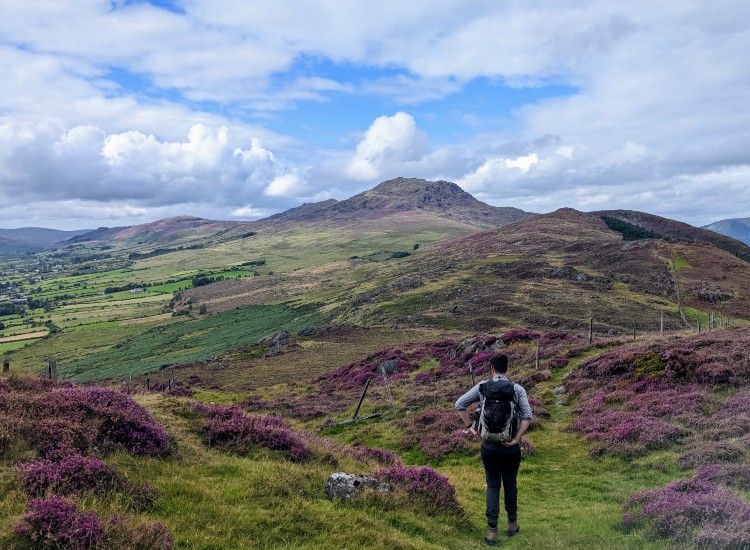
The research team, led by scientists from Trinity College Dublin and including those from the UK, USA, and the Geological Survey of Northern Ireland, studied rocks across Carlingford Mountain which formed as the magma system inflated beneath the volcano over thousands of years. By studying the microscopic texture of the rocks and the compositions of crystals, the team developed a model of how the magma system evolved through time.
The results of the study show that, in contrast to the popular picture of volcanoes being underlain by a liquid magma chamber, the Carlingford system developed in a complex pulsatory fashion. Liquid-dominated magma chambers were at times present but these were punctuated by long periods where the crust beneath the volcano was in a “mush” state – dominated by crystals with very little liquid rock (a texture very similar to a slushy drink).
Although Carlingford Mountain is extinct, the team believe that the same processes operate beneath active volcanoes today. By using fossilised remnants of ancient magma bodies to reconstruct the ‘lifetime’ a volcano, the study provides new information about how these contemporary systems develop, evolve and ultimately erupt.
Jack Beckwith, a PhD student in Trinity’s School of Natural Sciences, and lead author on the paper, said:
“This is a really interesting observation that addresses an ongoing debate as to whether magmas exist beneath volcanoes as liquid-rich vats or as crystal-rich slurries. Recent studies have shifted opinion towards the slurry model, but it is still not clear how this slow, crystalline magma erupts at the surface. At Carlingford, we see that magmas can actually switch between these two states over short periods in geological terms, creating opportunities for more fluid magmas to ascend and fuel eruptions.”
Dr Mike Stock, from Trinity’s School of Natural Sciences, and principal investigator on the study (pictured on site in the above image), said:
“Volcanoes are a major natural hazard but geologists struggle to understand them because we can’t take rock samples from several kilometres beneath Earth’s surface in active settings. This study shows that ancient extinct volcanoes in Ireland can provide really important new insights – thanks to glaciers eroding away their overlying rocks, we’re able to directly see inside their magmatic plumbing systems. They are perfect analogues for their younger brothers and sisters on modern-day Iceland!”
What is the potential impact of this research?
This work improves our understanding of how volcanoes evolve and ultimately erupt. It challenges the long-established picture that all volcanoes are underlain by liquid magma chambers that feed eruptions.
Additionally, it highlights the incredible importance of Irish geology for understanding Earth processes. It shows that mountains in Co. Louth are fossil remnants of ancient volcanoes which can provide a unique window into processes operating between active systems today.
This study was published in the Journal of Petrology. It was funded through the Research Ireland Frontiers for the Future programme and supported by Geological Survey Ireland. A PDF copy of the paper can be read here.
ENDS
Media Contact:
Thomas Deane | Media Relations | deaneth@tcd.ie | +353 1 896 4685