"Don't panic": AI's future role in healthcare debated at Trinity
Posted on: 01 October 2026
At the free event at Trinity College Dublin, organised by the Fellows of Trinity College Dublin and chaired by Professor Rose Anne Kenny, experts explored the future of medicine, discussed whether human doctors remain essential, and examined the role of AI in biopharma and surgery.
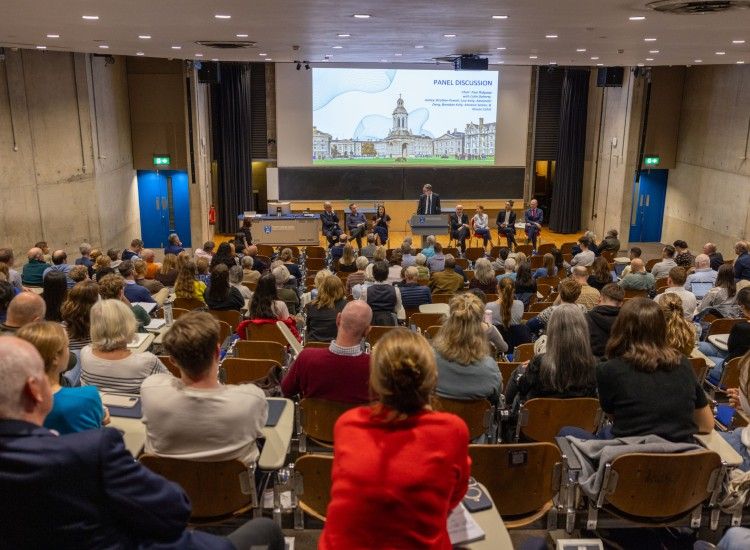
Cautious optimism - plus a healthy dose of scepticism - were to the fore this week at a public event where experts discussed the role artificial intelligence will play in healthcare, surgery and drug discovery.
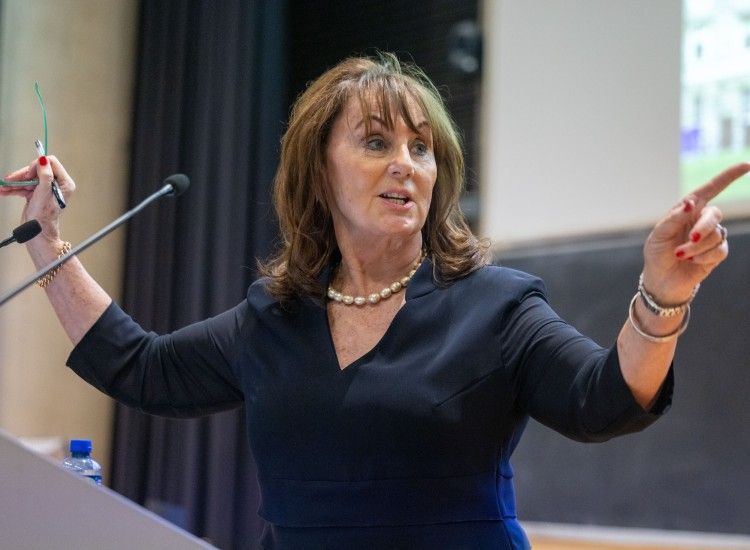
At the packed free event at Trinity College Dublin - called AI in our Healthcare: Promises, Pitfalls and the Path Ahead - organised by the Fellows of Trinity College Dublin and chaired by Professor Rose Anne Kenny, Professor of Medical Gerontology (below), experts explored the future of medicine, discussed whether human doctors remain essential, and examined the role of AI in biopharma and surgery.
“Don’t panic”, were the parting words from Professor of Psychiatry Brendan Kelly who pointed out that "waves of existential panic” over a new technology are nothing new, as he cited historic quotes from people alarmed by novelties such as the motorcar, the radio and the dawn of the Internet.
“Ultimately, healthcare is about people” he said.
Neurologist and Head of the Trinity School of Medicine Prof. Colin Doherty disagreed , saying he was “very, very worried” about the impact of generative AI on medicine. "There is a serious problem with dumbing down of skills.”
Alexander Deng, director of the NHS Fellowship in Clinical AI, spoke about his work while science writer Melanie Senior spoke about how AI is accelerating the pace of drug discovery.
Ronan Cahill, Professor of Surgery at UCD and Mater Hospital, discussed the use of robotics and AI in surgery, pointing out that surgeons already delegate task execution to more junior colleagues.
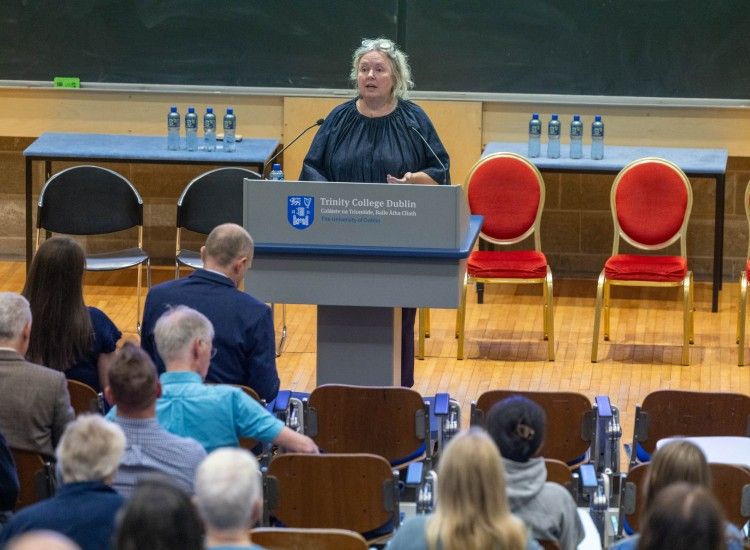
Provost Dr Linda Doyle (above), who spoke at the start of the event, also noted that cutting edge technologies have always been used in healthcare.
“It’s a world that is used to embracing technology,” she said. “The question is what can we do to make a better world?”
The event ended with a panel discussion on "Who is in charge and taking responsibility?" with Paul Ridgway (Professor of Surgery, Trinity College Dublin), Colin Doherty, Ashley Stratton-Powell (Expert Assessor in benefit-risk evaluation at the Medicines and Healthcare products Regulatory Agency) and Dr Lisa Kiely (Dermatology Specialist Registrar with the Royal College of Physicians of Ireland), joining the main speakers.
A medical student asked from the floor if they needed to be concerned for their future career. Paul Ridgway summed up the panel’s reaction with a succinct: “You’ll be okay, don’t worry.”
ENDS
Media Contact:
Catherine O’Mahony | Media Relations | catherine.omahony@tcd.ie