Trinity team leads development of global Food Sharing Compass to transform local food systems
Posted on: 20 November 2026
Our food systems are increasingly fragile, facing threats from climate change and conflict globally. The impact of these factors is most intense in urban and peri-urban areas that are home to the majority of the world’s population. In response, the CULTIVATE Consortium, led by Trinity, has launched its free online Food Sharing Compass to help communities, grassroots initiatives, food supply actors and local authorities build more sustainable and resilient urban and peri-urban food systems together through sharing food. Data from Dublin alone shows over 100 initiatives currently share food in the city, distributing more than 200,000 meals and avoiding more than 9,000 tonnes of CO₂-equivalent emissions through food redistribution.
As climate change, geopolitical instability and disruption to global supply chains expose the vulnerabilities of our food systems, a Horizon Europe-funded Innovation Action project led by researchers from Trinity has launched a Food Sharing Compass to help the world build more sustainable, connected and resilient food systems.
The CULTIVATE Consortium, which includes food sharing initiatives, municipalities, social innovators and researchers, has co-created the Food Sharing Compass as a free online platform designed to make food sharing an integral part of resilient, locally rooted food systems.
The Compass contains five tools: A map to help actors explore food sharing initiatives in their local area and internationally; a Community of Practice to connect and exchange experiences of sharing; a library of ways to mobilise citizen engagement in sharing; a calculator to assess the sustainability impacts that sharing creates; and a good governance database to help actors overcome barriers to sharing.
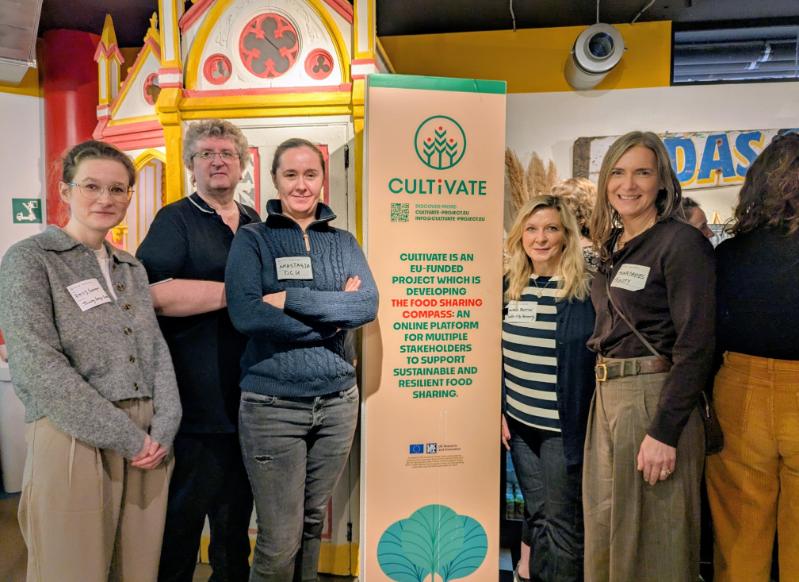 Some members of the Cultivate team, including project manager Daisy Gallagher (left) and Prof. Anna Davies (right).
The researchers are launching the Compass in Brussels today at a special event to mark both the conclusion of the four-year project and the beginning of the next phase of dissemination and engagement with the tool.
“From community gardens and food redistribution projects to social supermarkets and urban farms, food-sharing initiatives are already delivering significant environmental, economic and social benefits. Yet many remain isolated, underfunded and largely invisible to the policymakers and institutions that could help them grow,” said Anna Davies, CULTIVATE lead and Professor of Geography, Environment and Society in Trinity’s School of Natural Sciences.
“The Food Sharing Compass we have developed aims to change this by bringing together five interactive tools on one platform to help diverse actors make food sharing thrive for people and the planet.”
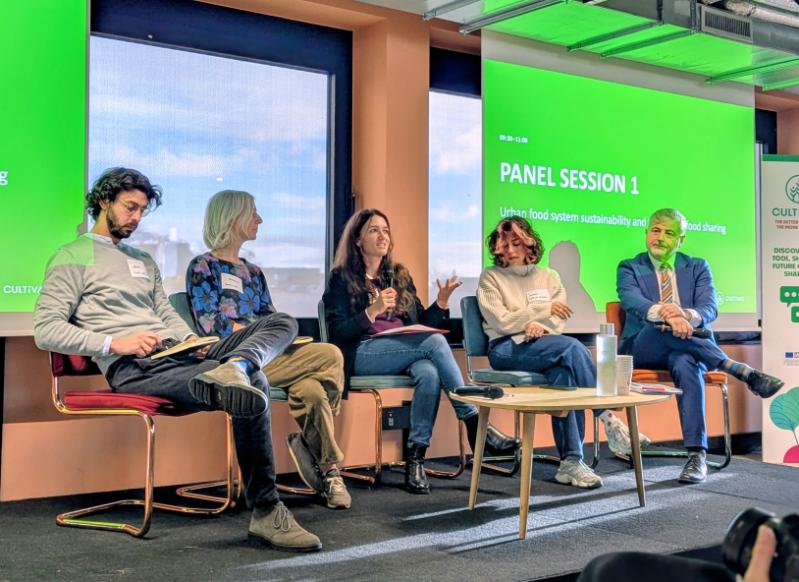 A panel session at the launch in Brussels.
Case Study One: Dublin’s food-sharing impact
The potential of this joined-up approach has already been demonstrated close to home for the Trinity team, as using the Food Sharing Map and the sustainability impact assessment component of the Food Sharing Calculator, they were able to estimate that Dublin’s initiatives collectively:
- Produce 17.49 tonnes of food annually
- Share 217,802 meals
- Avoid 9,158 tonnes of CO₂-equivalent emissions through food redistribution
- Involve 830 active volunteers
- Engage more than 16,500 participants in educational events.
“These conservative estimates based on only those initiatives that have a digital presence demonstrate how mapping and impact assessment can reveal the otherwise hidden contributions of community food initiatives, helping local authorities make better-informed decisions about investment and support, supporting citizens to engage with food sharing, and identifying existing activity for food supply actors to connect with in their local areas ” added Prof. Davies.
“It also highlights the potential of the compass to identify community need and target support with greater precision helping to expand social impact where there’s most demand.”
Alan Sherry, Senior Executive Officer of the Climate Action unit in Dublin City Council, Dublin City Council, said: “The mapping methodology developed by CULTIVATE is a game-changer for discovering hyperlocal initiatives. By identifying the social impact of food sharing within the Sharing Solutions framework, we can now visualise exactly where community resilience is strongest and where support can be targeted. Having a unified map of these initiatives allows [us] to implement projects ... with more precision and social equity.”
Case Study Two: Barcelona’s Espigoladors, from local action to policy change
The impact of food sharing can also extend beyond individual communities to influence wider food systems and policy, with Espigoladors, based in Barcelona, demonstrating how.
The non-profit initiatives works with volunteers to collect surplus agricultural produce left in fields after crop collection (“gleaning”), transforming the collected food into jams, sauces and vegetable pâtés so that it is not wasted. Some of the products are sold at famers markets, some are stocked in a nearby social supermarket meeting local need affordably. Espigoladors not only rescues food, it also provides training and skills development opportunities for local people expanding social inclusion.
Through CULTIVATE’s Community of Practice, Espigoladors has connected organisations across Spain and advocated successfully for the inclusion of gleaning as a food-loss prevention strategy in Spanish law. Its experience demonstrates how connecting grassroots initiatives can amplify their influence and drive systemic change.
What is the potential impact of this research?
Ultimately, the Food Sharing Compass will help countless individuals and initiatives build a more resilient food future by growing, cooking and eating food together. Food sharing provides opportunities to eat better, reduce loneliness and build social connections, as well as lowering carbon equivalent emissions by redistributing food and preventing food loss and waste.
Crucially, the Compass also supports impact measurement and assists FSIs with overcoming policy barriers, helping to connect practitioners with policymakers to contribute to lasting change.
Trinity’s Daisy Gallagher, CULTIVATE’s project manager, said: “Food sharing isn’t just about reducing waste or addressing food poverty; it also offers an opportunity to strengthen community relationships, support local food economies and build more diverse, equitable and sustainable food systems.
“Another important aspect of this project that I’m especially proud of is our focus on collating existing examples of good practice and sharing them with networks of people all around the world, which means good ideas travel more quickly and make a longer-lasting impact far beyond the spot in which they were first cooked up.”
The platform is now live and free to access via https://cultivate-project.eu/project/. Communities, citizens, organisations and policymakers are invited to explore its tools, connect with others and help build a more resilient food future.
Media Contact:
Thomas Deane | Research Communications Manager (STEM) | deaneth@tcd.ie | +353 1 896 4685