
From quantum computers to earthquake detection: global experts explore future of optical communications
Posted on: 13 October 2026
A three-day summer school brought together researchers, students and industry experts to examine the technologies shaping future communications networks.
How can optical fibre help connect quantum computers, detect earthquakes beneath the ocean and reduce the energy demands of AI data centres?
These were among the questions explored at the Summer School on Optical Communication 2026, which brought leading researchers from Ireland, Europe and the United States to Trinity College Dublin from 2–5 September.
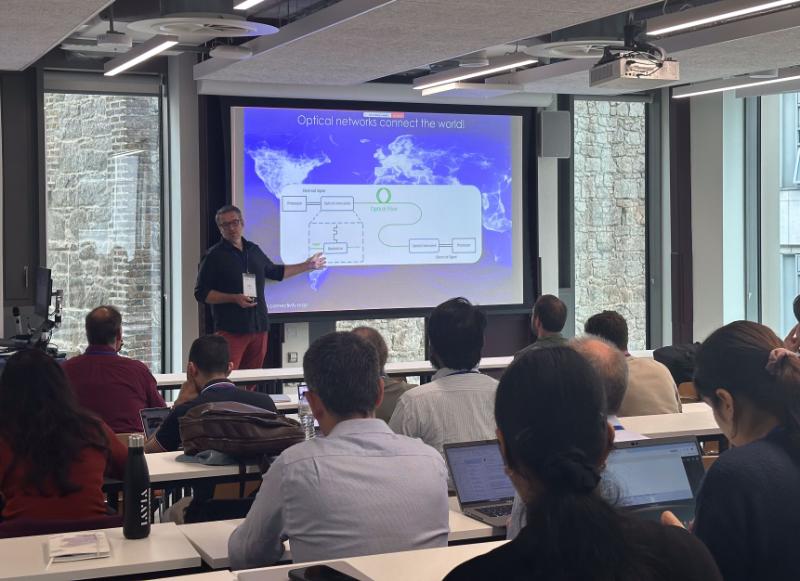
Organised by the ICON Project and the CONNECT Research Ireland Centre for Future Networks and Communications headquartered at Trinity, the programme gave participants an opportunity to learn from internationally recognised experts and explore emerging research across optical, quantum and AI-enabled communications.
Welcoming participants, Professor Dan Kilper, Director of CONNECT at Trinity College Dublin, said: “Events like this are about much more than the technical programme. They bring students, researchers and industry together to exchange ideas, learn from one another and build connections.
"This mix of perspectives is often where a conversation becomes an idea, an idea leads to collaboration and, ultimately, that collaboration leads to real-world impact.”
Connecting the quantum technologies of the future
The opening day focused on quantum communications and quantum networking, including how optical technologies could help connect quantum computers, enable secure communications and support future quantum networks.
In a plenary address, Professor Marko Lončar of Harvard University discussed quantum optical interconnects and the potential of photonics to connect different quantum computing systems.
Professor Lončar said: “Photonics already connects our information world through optical fibres. The question now is how we can use that expertise to connect quantum systems and enable the next generation of quantum technologies.”
His presentation explored technologies that could allow separate quantum processors to be connected as larger, modular quantum computing systems.
The day also featured a lecture on quantum optical networks from Professor Kilper and a panel discussion on the future of quantum communications. Dr Leonardo Bacciottini of the University of Massachusetts Amherst introduced key quantum concepts, while Dr Rui Lin of Chalmers University of Technology examined how future quantum networks could be managed and controlled.
From communications cables to global sensors
The second day demonstrated how optical fibre can do much more than carry communications traffic.
Mikael Mazur of Nokia Bell Labs explored how existing terrestrial and subsea telecommunications cables could also operate as large-scale sensor networks. This could support environmental monitoring and the detection of seismic activity in parts of the world where conventional sensors are limited.
Dr Kaida Kaeval of Tallinn University of Technology examined how data from communications networks and dedicated sensing equipment could be combined to monitor infrastructure. Her presentation also highlighted the practical importance of cost, reliability and common industry standards.
The programme then turned to the growing role of artificial intelligence in communications. Professor Massimo Tornatore of Politecnico di Milano outlined how machine learning can support network optimisation, resource allocation, performance monitoring and failure management.
The day also included a lecture by Professor Marco Lucamarini of the University of York on quantum key distribution, a technology that uses quantum principles to create and share secure encryption keys. He discussed the challenges of extending its transmission range, strengthening the security of practical systems and developing smaller, more widely deployable devices.
In the final lecture, Professor Ioannis Tomkos of the University of Patras examined how optical signal processing could reduce the bandwidth and power limitations facing future AI data centres. Moving more processing from electronics into the optical domain could help meet rapidly growing demands for faster and more energy-efficient connectivity.
The following day, the summer school concluded with a practical AI hackathon led by CONNECT postdoctoral researcher Dmitrii Briantcev. Participants worked with machine-learning tools and a digital twin of an optical network, gaining hands-on experience of how AI can support network monitoring, management and optimisation.
Connecting research with real-world infrastructure
Industry partnerships were an important part of the programme, connecting emerging research with the infrastructure needed to test and deploy new communications technologies.
The Summer School on Optical Communication 2026 was supported by Aurora Telecom, the University of Patras and Pilot Photonics. Aurora Telecom’s national fibre network supports advanced research by CONNECT, including optical and quantum communications experiments between Dublin and Galway.
James Freeman, ‘Fibre Manager’ in Aurora Telecom, said: “The pace of innovation in communications technology is accelerating, making collaboration between industry and academia more important than ever. Aurora Telecom works closely with CONNECT on active research programmes, with our national fibre network providing a platform for the development, testing, and validation of next-generation optical and quantum communications technologies.
“We were delighted to sponsor this year’s summer school workshop and contribute to discussions on the future of optical and quantum-enabled networks that will turn innovative ideas into real-world solutions.”
CONNECT also acknowledges all speakers, organisers and participants who contributed to the programme, as well as the teams behind the ICON, ECO-eNET, SENSEI, FLEX-SCALE and PROTEUS-6G projects.
Media Contact:
Thomas Deane | Media Relations | deaneth@tcd.ie | +353 1 896 4685